Electrical fires kill hundreds of Americans every year and destroy tens of thousands of homes. What makes them particularly dangerous is that they usually start inside walls, behind outlets, or inside electrical panels — places you can't see. By the time you smell smoke, it's often too late. The good news: these fires almost always announce themselves first. Learn the nine warning signs, and you can stop an electrical fire before it starts.
1. Burning Plastic or Fish Smell
A distinct smell of melting plastic — some people describe it as a dead fish smell — coming from an outlet, switch, or panel is the clearest warning sign. It means something is overheating inside the device. Stop using that circuit immediately. Turn off the breaker. Call a licensed electrician same day. This is not a "wait until Monday" situation.
2. Discolored or Scorched Outlets
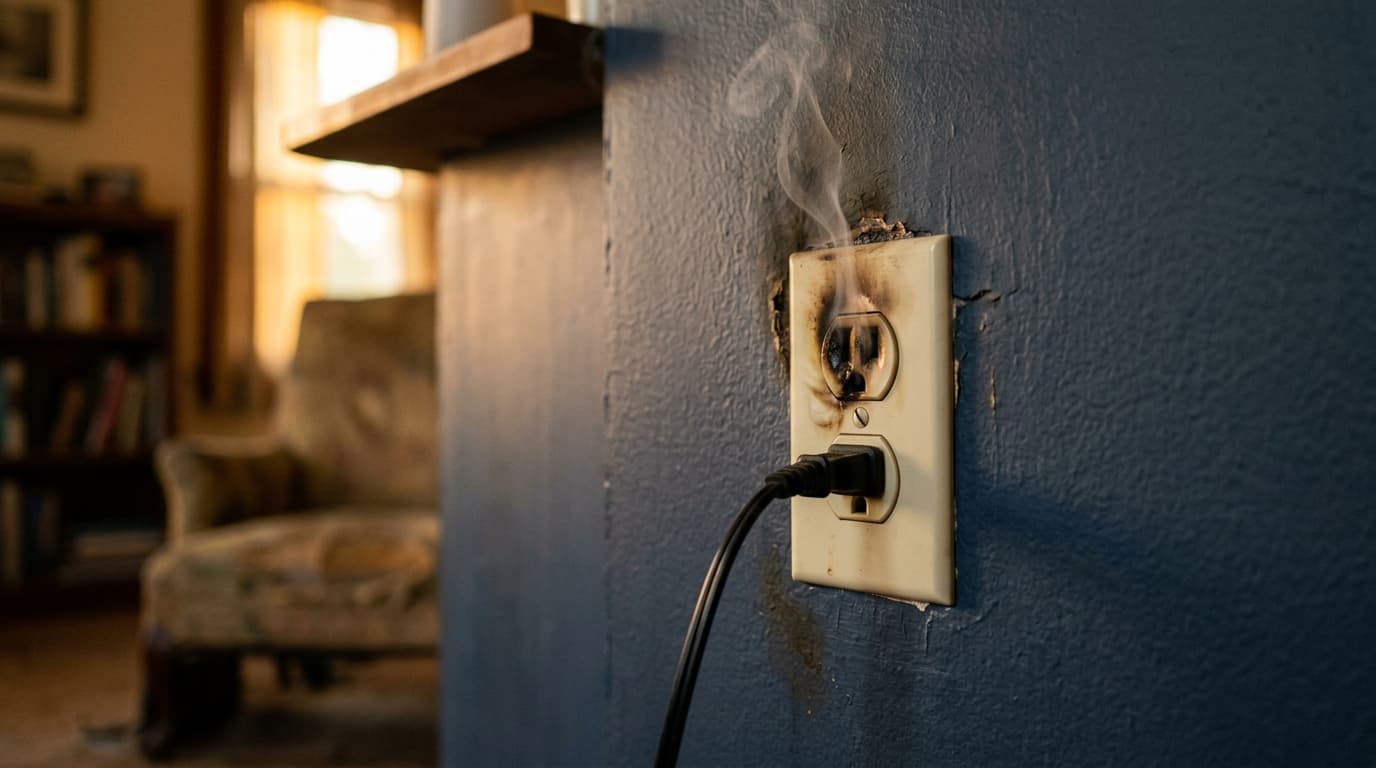
Brown or black marks around an outlet — especially near the prongs — mean arcing or overheating has already happened. Even if the outlet still works, the heat has damaged the backside connections. Replace immediately.
3. Breakers That Trip Repeatedly
A breaker tripping once is doing its job. A breaker that trips every few days — or that trips and then won't reset — is signaling a real problem. Options include: overloaded circuit, short circuit, failing breaker, or ground fault. All of them need diagnosis, not ignoring.
4. Warm or Hot Outlets and Switches
Your outlets and switch plates should be at room temperature. If you touch a faceplate and it's warm — or hot — that means heat is being generated inside. Could be a loose connection, a backstab that's failing, or an overloaded circuit. Kill power to that circuit and get it assessed.
5. Flickering or Dimming Lights
If lights dim when an appliance kicks on (AC compressor, microwave) that can be normal for older homes. If lights flicker randomly, flicker across multiple rooms at once, or flicker for a few seconds and then stabilize — that often points to a main lug issue at the panel, a bad neutral somewhere in the service, or a service-side utility problem. All require professional evaluation.
6. Crackling, Buzzing, or Humming Sounds
Electricity is silent when it's flowing correctly. Any sound coming from an outlet, switch, or panel means something is arcing or vibrating loose. Buzzing transformers (doorbells, AV equipment) are normal. Buzzing breakers or outlets are not.
7. Frequent Shock or Tingle From Appliances
If touching your washer, dryer, or fridge gives you a tingle, that's current leaking to the metal chassis because of a grounding problem. Could be a miswired outlet, a damaged cord, or a failure inside the appliance. Either way, don't keep using it.
8. Old or Recalled Panel Brand
If your panel is Federal Pacific, Zinsco, Pushmatic, Challenger, or Bulldog, you have a fire hazard even when nothing appears wrong. See our dedicated posts on Federal Pacific and Zinsco panels. Replacement is the only safe answer.
9. Rodent Activity Near Wiring
Rats and mice chew insulation off wires. Exposed copper conductors in an attic or crawlspace will eventually arc to something and start a fire. If you're seeing droppings, nesting material, or chewed insulation, assume wiring has been damaged and get it inspected. This is a huge problem in the attics of Tarzana, Woodland Hills, and the hillside areas of Calabasas.
What to Do If You Notice Any of These
- Turn off the affected circuit at the breaker if you can identify it
- Unplug whatever was on the circuit
- Don't keep toggling breakers trying to diagnose
- Call a licensed electrician
If you smell active smoke, see sparks, or see flames — call 911 first. Electrical fires are class C and need a class C extinguisher if small enough to fight safely. Water makes them worse.
The 24/7 Side of This
Electrical emergencies don't respect business hours. We take after-hours calls for active fire risk situations — smoke, sparking, burning smells, warm panels. The owner personally responds to emergency calls.
See our emergency electrician service or call 818-852-4910. Day or night.
Need help with this?
Call the owner directly for a free consultation. No dispatchers, no runaround.
Call 818-852-4910