
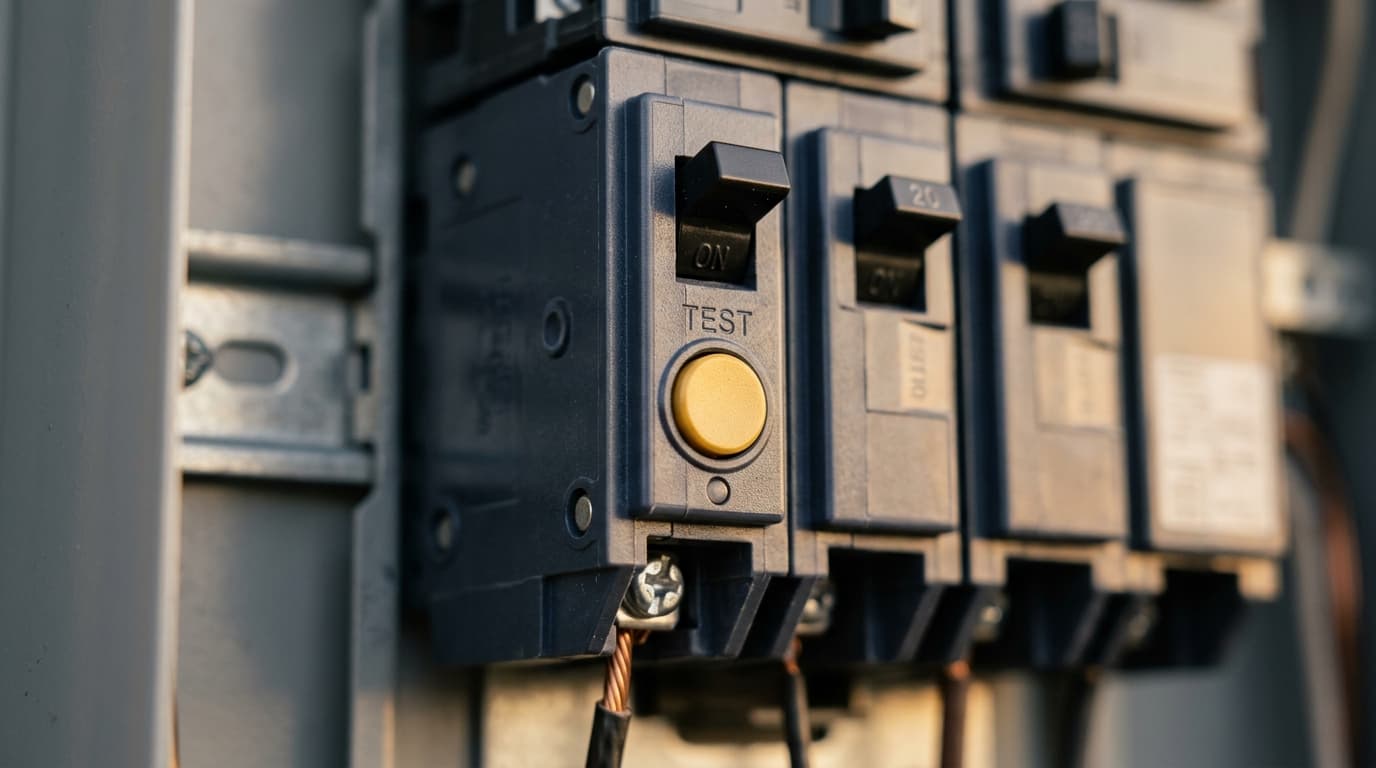
If you've had an electrical project quoted recently and the invoice includes "AFCI breaker" or "GFCI outlet" line items that seem to cost more than regular breakers, there's a reason. The California Electrical Code (CEC) — adopted from the NEC — has progressively required more circuits to be protected by advanced breaker technology. Here's the current state of the code as of the 2026 update.
GFCI vs AFCI: What's the Difference?
GFCI (Ground Fault Circuit Interrupter)
Protects against electric shock from current leaking to ground — like when you drop a plugged-in hair dryer into a sink. GFCIs detect the mismatch between outgoing and returning current (as little as 4–6 milliamps) and trip the circuit in about 1/40 of a second. This saves lives in wet locations.
AFCI (Arc Fault Circuit Interrupter)
Protects against electrical fires caused by arcing — a damaged wire, a loose connection, a nail driven through a wire behind drywall. AFCIs detect the specific current signature of dangerous arcs and trip the circuit before a fire can start. This is the more recent technology and the one that keeps expanding.
Where GFCI Is Required in 2026
Per CEC 210.8, GFCI protection is required for receptacles in:
- All bathrooms
- Garages and accessory buildings
- Outdoor outlets
- Crawl spaces
- Kitchens — all countertop receptacles
- Kitchen dishwasher
- Within 6 ft of sinks, bathtubs, shower stalls
- Basements (finished and unfinished)
- Laundry areas
- Pools, spas, hot tubs, and within 20 ft
- Boathouses
- Within 6 ft of utility tubs / laundry sinks
Where AFCI Is Required in 2026
Per CEC 210.12, AFCI protection is required for all 15A and 20A branch circuits in:
- Kitchens
- Family rooms, living rooms, dens
- Bedrooms
- Dining rooms
- Hallways
- Laundry areas
- Closets
- Sunrooms
- Parlors
- Libraries
- Similar rooms
In practice: just about every 15A and 20A branch circuit in a living space needs AFCI protection.
Dual-Function Breakers (DFCI/CAFCI)
Many modern circuits need both GFCI and AFCI protection — kitchen and laundry being the most common. Manufacturers like Square D, Siemens, and Eaton make combination breakers that do both. These are called DFCI or CAFCI. They cost more but cover both requirements in a single breaker slot.
Does Existing Wiring Need to Be Upgraded?
Generally no. CEC applies to new work, alterations, and extensions — not to existing installations that were code-compliant when installed. But there are exceptions:
- Panel replacements: when you install a new panel, breakers must meet current code
- Circuit extensions: extending a circuit into a newly renovated room triggers current code
- Outlet replacement: replacing an outlet in a location that now requires GFCI means you install a GFCI outlet (this is a cheap, easy upgrade)
When we do a panel upgrade, this is the single biggest reason the cost might be higher than expected — every new breaker in the panel needs to be a CAFCI or GFCI depending on what room it feeds. At $45–$65 per advanced breaker vs $8 per standard breaker, a 30-slot panel adds up fast. But it's the law, and it meaningfully improves safety.
Common "Nuisance Trips"
AFCIs are more sensitive than old-school breakers. Some appliances — certain vacuums, treadmills, old freezer compressors — can cause nuisance trips. Modern AFCI breakers have better discrimination than early models (2002–2012 era), but the occasional nuisance trip still happens. The fix is usually: move the appliance to a different circuit, or have the breaker swapped to a newer version.
GFCI Resets That Won't Reset
GFCI outlets and breakers wear out, especially in outdoor locations exposed to moisture. If your GFCI won't reset, try: (1) unplug everything on the circuit and reset, (2) if it holds, something plugged in has a ground fault; (3) if it won't hold empty, the GFCI itself has failed. Replacement is straightforward for a licensed electrician.
Enforcement
During permitted work, LADBS inspectors will verify AFCI and GFCI compliance. Skipping these is not an option on permitted work. On unpermitted DIY or unlicensed work, you can skip code requirements — but you're also creating the unsafe conditions these technologies were designed to prevent.
When to Call
If your GFCI or AFCI is tripping repeatedly, don't replace it with a standard breaker to "make the problem go away." The breaker is telling you something. Call 818-852-4910 and we'll diagnose. See our residential services for more.
Need help with this?
Call the owner directly for a free consultation. No dispatchers, no runaround.
Call 818-852-4910