
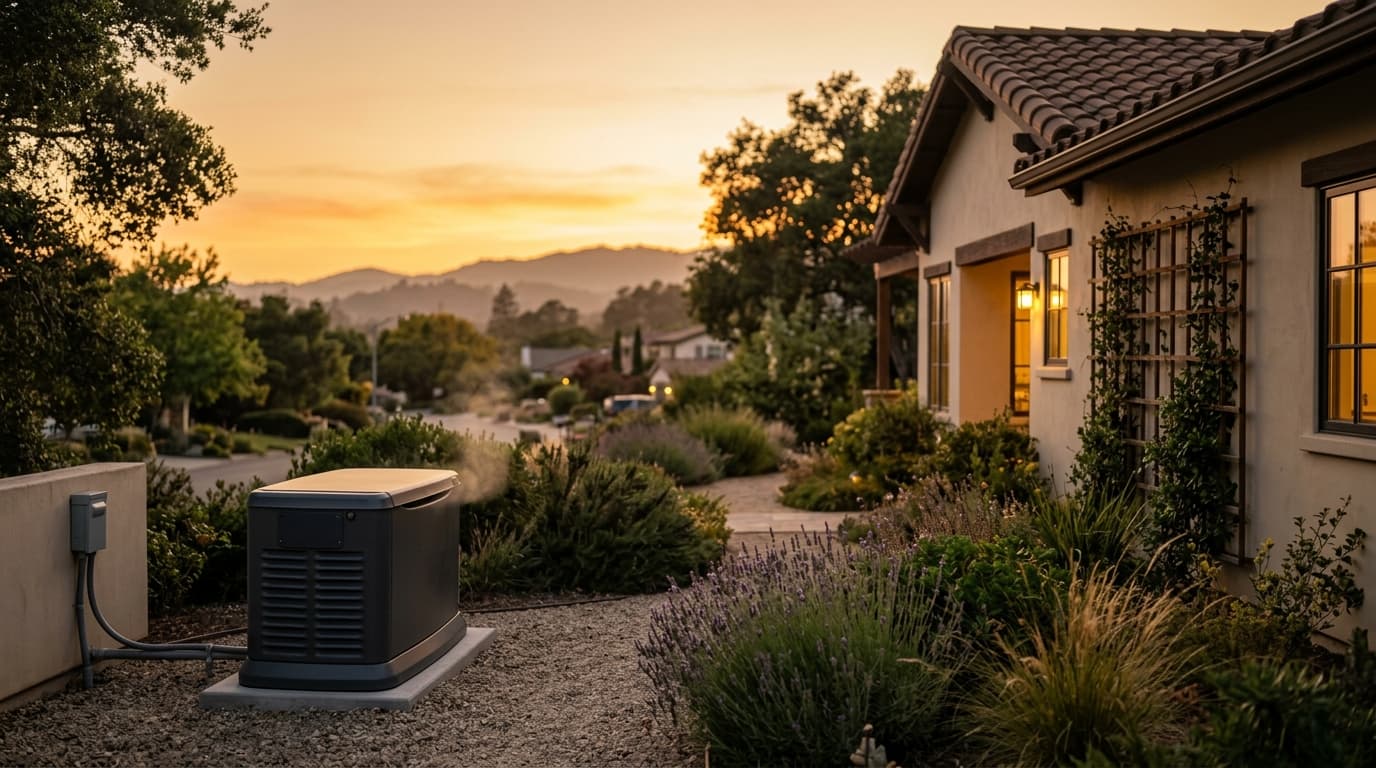
Southern California wildfire season now stretches essentially year-round, and with it come PSPS events — Public Safety Power Shutoffs — that can leave your home dark for hours or days. A whole-home standby generator is the most reliable way to keep running through outages. But sizing one is where most homeowners get into trouble. Here's how we do it.
Don't Just Buy "The Biggest One"
Oversized generators cost more upfront, more in fuel, and more in long-term maintenance. They also short-cycle, which wears out the engine and control board. Undersized generators overload their automatic transfer switch during high demand and nuisance-trip. The goal is to match the kW to your realistic peak load — not your theoretical worst case.
Step 1: List What You Actually Need During an Outage
There's a difference between "my house's total load" and "what I need running during a 2-day outage." Most of our LA clients prioritize:
- Refrigerator and freezer
- HVAC — usually one AC zone or the heat pump
- Critical lighting (kitchen, hallway, bedrooms)
- Wifi router, modem, basic electronics
- Garage door opener
- Well pump (if you have one)
- Medical equipment (CPAP, oxygen concentrator)
- Some receptacles for charging phones, laptops, EVs at reduced rate
What typically doesn't make the list: electric dryer, oven, hot tub, EV charger at full 48A, pool equipment. These can all be off or load-shed during an outage.
Step 2: Run the Numbers
Every Generac, Kohler, Cummins, or Briggs & Stratton unit publishes a kW rating. As a rough guide:
- 10–14 kW — small home, gas heat, minimal AC (one small zone). Enough for essentials.
- 18–22 kW — the sweet spot for most SFV homes. Runs one AC, fridge, kitchen, lights, wifi, and medical equipment comfortably.
- 24–26 kW — larger home with multiple AC units or heat pump, or an EV charger needed during the outage.
- 32–48 kW — estate-size homes with multiple HVAC zones, spa, or well pump.
The catch: it's not just kW. It's also what kind of loads. An AC compressor has inrush current 3–5x its running draw when it starts. A generator that can handle the running load may not be able to start the compressor. This is where load management comes in.
Step 3: Load Management Is Your Friend
Modern standby generators (Generac PWRcell, Kohler KOHLER Home Energy, etc.) include automatic load management. Instead of sizing for everything running simultaneously, the ATS sheds non-critical circuits when total load approaches capacity. This lets an 18kW unit back a house that would traditionally need a 26kW — and saves thousands on the generator itself.
Step 4: Fuel Source
In LA, 99% of what we install runs on natural gas. SoCalGas will hold pressure through almost any outage short of an earthquake. Propane is an option for homes in Calabasas and upper Thousand Oaks without gas service — but you'll need a 500+ gallon propane tank for meaningful runtime. Diesel is rare for residential.
Step 5: Placement and Permitting
Generators need at least 18" of clearance from the house, 5 feet from operable windows, and a proper concrete pad. LA City requires a gas permit, electrical permit, and often a planning signoff for placement. We handle all three as part of the install.
Real-World Example: A 2,800 sq ft Home in Porter Ranch
Client wanted to run a 4-ton AC, fridge, kitchen outlets, wifi, and lighting during outages. Load calc came out to 14 kW running with 18 kW starting. We installed a Generac 22 kW natural gas unit with a 200A ATS. Two PSPS events later, the system has run flawlessly both times — including powering the AC during the hot September 2025 shutoff.
Get a Real Quote
We don't quote generators over the phone. The owner comes to the house, walks the property, checks the panel and gas line, and gives you a written flat-rate quote — typically same day. See our generator installation service or call 818-852-4910.
Need help with this?
Call the owner directly for a free consultation. No dispatchers, no runaround.
Call 818-852-4910