
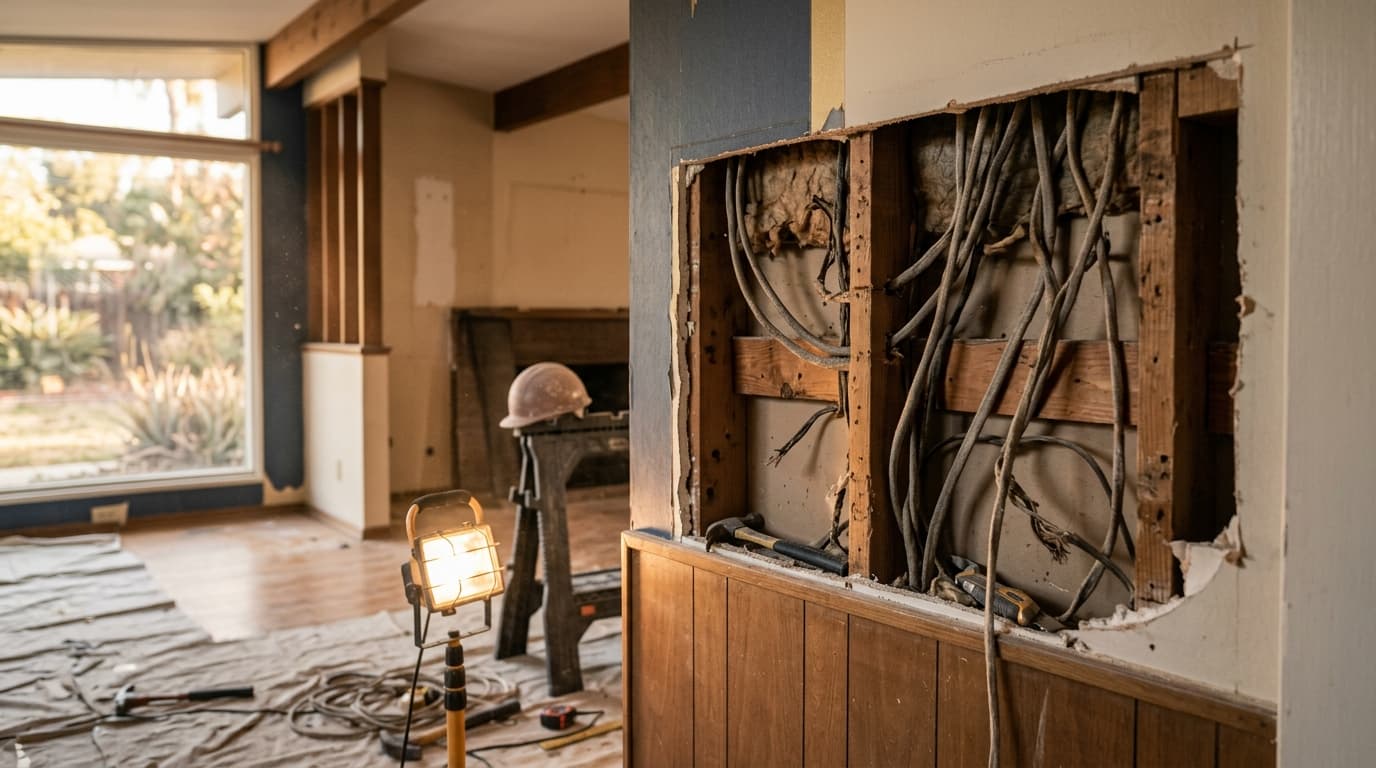
The San Fernando Valley built out between the 1940s and the 1970s — Chatsworth, Northridge, Reseda, Van Nuys, and the rest. That means a huge number of homes in the Valley are now running on 50–80-year-old wiring. Some of it is fine. A lot of it isn't. If you're considering a rewire, here's the honest playbook.
Types of Old Wiring You Might Have
Knob and tube (pre-1950s)
Individual insulated conductors run through ceramic knobs and tubes. Common in homes built 1920s–1950s. Problems: no ground wire, degraded insulation from age, can't be safely buried in insulation (fire risk), not recognized by modern insurers.
Cloth-jacketed Romex (1940s–1960s)
Early Romex with fabric sheathing instead of plastic. Often has degraded insulation. You'll see it in a lot of Van Nuys and Reseda homes.
Aluminum branch wiring (1965–1975)
Used during the copper shortage. Fire risk at connection points due to oxidation and thermal expansion. Solid-strand aluminum in branch circuits is particularly problematic.
Ungrounded two-wire (any era pre-1960s)
Two-prong outlets, no ground wire. Not inherently unsafe, but doesn't meet modern code and can't safely power modern electronics.
Signs Your Home Needs Rewiring
- Two-prong outlets throughout
- Breakers that trip under normal loads
- Warm or discolored outlets
- Flickering lights
- Burning smells
- Knob and tube visible in the attic or basement
- Insurance carrier asking for an electrical inspection
- Fuse panel (not breakers)
Partial vs Full Rewire
Full rewires are disruptive and expensive — $15,000–$45,000+ depending on home size and wall access. Often the right approach is a partial rewire: address the dangerous areas (kitchen, bathroom circuits, knob and tube runs through insulation) and leave sound wiring in place. A licensed electrician can assess what actually needs to be replaced.
What a Full Rewire Includes
- Removal of old wiring where accessible
- New 12 AWG and 14 AWG copper Romex for branch circuits
- AFCI and GFCI protection where code requires
- New outlets and switches (Decora style if desired)
- New ceiling fixtures and fan boxes if needed
- New panel (usually bundled — old homes with old wiring usually have old panels too)
- Full permit and inspection
- Drywall patching (may or may not be included depending on scope)
The Drywall Question
This is what homeowners always ask: "Do you have to tear open my walls?" The answer is: some of them, yes. A skilled electrician minimizes the damage by pulling wires through chases, using existing penetrations, and fishing walls where possible. But realistic expectation: you'll have 10–30 patch areas to finish after a full rewire, depending on home layout.
We offer two models: (1) we do the electrical and leave clean access holes for your painter/drywaller, or (2) we coordinate drywall and finish work for an all-in price. Most of our clients choose #1 because their paint colors are specific.
Timeline
Typical 1,800–2,500 sq ft SFV rewire: 7–14 working days for the electrical, plus 3–5 days for drywall patching and paint. You don't need to move out — we work in sections and restore power each evening.
Permit and Inspection
Rewires always require permits. LADBS will do an in-progress rough inspection before drywall patching and a final inspection after. We schedule both and meet the inspector on-site.
Insurance Implications
Post-rewire, most insurers will reduce your premium or approve policies they would have denied. We provide the final permit signoff and a summary letter your insurance company can keep on file.
Cost Range
Flat-rate quoted, but for reference:
- Small partial rewire (kitchen + baths + panel): $8,000–$14,000
- Full single-story 1,500–2,000 sq ft rewire + panel: $18,000–$28,000
- Full two-story 2,500+ sq ft rewire + panel + service upgrade: $28,000–$45,000+
The Owner-on-Every-Job Promise
A rewire is a big job. You want to know the same person is there every day, understands the scope, and makes decisions when problems come up behind the drywall. That's why the owner is on every rewire we do. Not a subcontractor. Not a random tech.
Considering a rewire? Call 818-852-4910 for a free walk-through. See our residential electrical services page for more.
Need help with this?
Call the owner directly for a free consultation. No dispatchers, no runaround.
Call 818-852-4910